

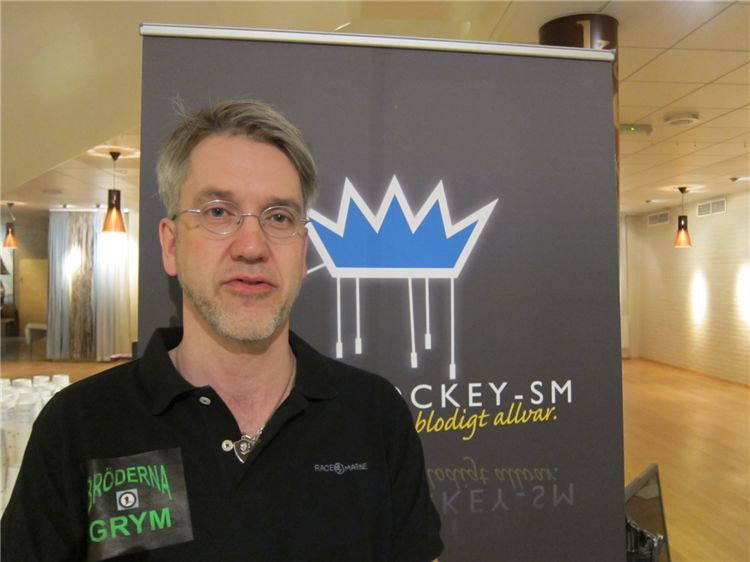
-Lasse, what was the reason of your comeback in table hockey after so long break?
The reason was that Oscar, my son, has found an interest in playing table hockey. As he was existed and wanted to compete with others we went to SM. I could, in the end, not resist taking part myself to see and feel the level of skills nowadays…
-What did you wait from this SM before it, and what was your impressions after? What are your best memories from SM this year?
I had a hope that my son should do well and find it even more fun to play (which was both fulfilled)….It was really a nice weekend for me and Oscar a “father and son” feeling where we both enjoyed the game, meeting new friends (and a lot of old friends!).
I liked also the overall feeling of table hockey now being very international and that the best players have taken the game to a new level. I was of course very impressed by Roni Nuttunen, Edgars Caics, Yanis Galuzo and the other top players. To see them playing triggers me. I enjoyed also seeing Thomas Pettersson doing so well, after all being one of the old boys.
-Which is a main difference between table hockey nowadays and 20-25 years ago? I mean the game style, moves and also some organization moments.
I’m very impressed by the high level in general and also the very high level among the top players. I was told earlier that the way of playing table hockey has not changed that much, but I must say that I do not agree. Maybe I did not see so many new combinations on “macro level”, I mean like a new “Loppan” or “Hjerpe” or “Backskott” (sorry my English terminology is a bit poor). I did however see a lot of new things on “micro” level, I mean small things like placing the puck differently when doing the “spjass” or shooting the puck from slightly new positions. I notice that the way of playing has become a bit more intense or even aggressive in some cases. In general the precision has clearly increased. One of the most apparent changes is that all players are standing except the old Swedes (smile). I need also to mention “YouTube” as a new possibility for our game. It will help the sport to be developed even faster.
-You saw almost all of the best players nowadays. Please, imagine the game between five best players-2011 against five best players 1990 (in their best years). Could you guess who will win this virtual game?
I’m afraid that the old players would lose in such a virtual game, no doubt. As any other sport also table hockey is being developed year by year. A more interesting (hypothetical) question would be if you gave the old players (still in their best years) one year of practicing in today’s table hockey environment. How soon would they adopt to the new style? Could they win one of the “Big six”? Yes, maybe!
-Are you planning to continue to play in some tournaments? And maybe win some “Big Six” in reality?
Everything is linked to Oscar. If he wants continue you might see me in more tournaments. To win titles I think will be difficult. I will focus on being a trainer for Oscar.
-And how serious is table hockey for Oscar now? Sweden need a new blood as never before, I think. As you could see, there are not so much young players in Sweden comparing to Finland, Russia, Latvia…
Oscar takes this quite serious at the moment. His practicing relatively good. The question will be if he will keep up the interest. I have heard about his ambitious targets and to reach them he will need a few years. We will see..
-You won SM 3 times in a row, what was the secret of your success?
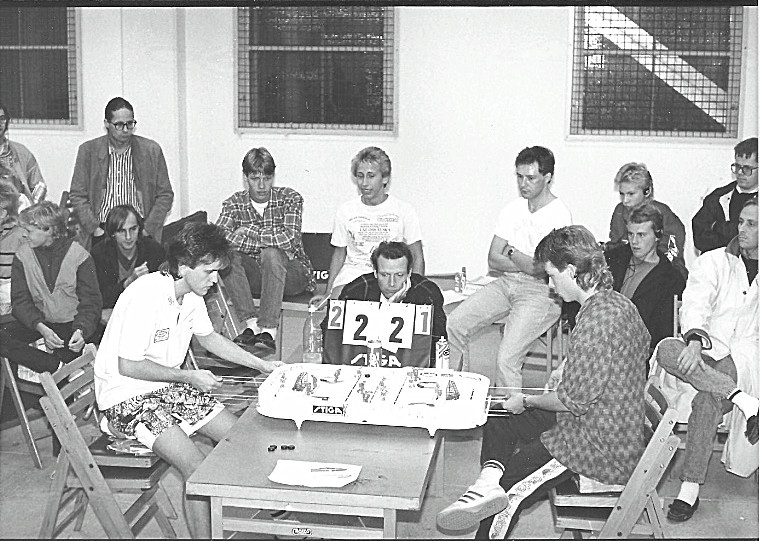
For me a good player needs to be all-round, be able to do all combination, be able to defend against all opponents, quickly see how to change the way of playing, be strategic. I tried to be as good as possible in all these areas and to simply practice a lot.
-How much time did you practiced and how you created your practice time?
I think my main difference compared to others at that time was that I practiced alone. This was during my university studies and playing table hockey was much more fun than anything else. I practiced more than I studied. We are talking hours… If Internet and “YouTube” would have been available at my time, I probably would have been completely absorbed by studying the latest development of my competitors.
-And who was your main competitors that time?
-When I started, my dream was to be able to beat Agdur, Stig Ankardal and Thomas Elfström… When I finally reached the top I did it by beating Thomas Pettersson who was at that time standing at the top as the guru and world inventor of many new revolutionary tricks. Later on I was challenged by Fredrik Johansson, Jörgen Sundqvist, the Orsa maffia (Kratz, Stener, etc...). In the end I had my battles with Jacob Lindahl who later on became the unbeatable for a number of years. I also had the opportunity to see Hans Österman developing his skills when I was back as active for a few years in the first part of the 1990’s (92-95)….
-Please, tell us something about your life nowadays. How do you spend your time?
I’m today a typical 46 years old Swedish guy with two boys and one (smiling) wife. Working too much (travels quite a lot). I like to work with our house and garden in my free time. As the time is limited it means that my possibility to play is that Oscar likes to play, I use my “family time account” when playing.
-There is lots of good tournaments in Europe now, is it interesting for you to visit some big tournaments outside Sweden?
It would be very exciting and fun to go to some tournaments outside Sweden. But that requires, though, some more planning as the travelling itself will be a bigger part of the event….
Have you ever been in Russia?
No, I have never been in Russia. I’m sure it would be an exciting experience. Maybe someday I’m able to see your great country and learn better how to play the new type of table hockey.
-There is some prize money on tournaments in Russia now. But I know that some Swedish players are not supporting it so much, thinking that it will kill fair play in table hockey. What do you think about it? Which way of future you would like to see in table hockey?
I see no problem in having prize money. If there would be a tendency of unfair play we need simply to be more professional, i.e. using referee, having more defined rules, maybe using videos to do replays…
And the last question, can you explain why in Sweden someone called Lasse, Kalle and not Lars and Karl. I mean why you are Lasse Henriksson, but for example Hans Osterman is not Hasse or Lars Fridell is not Lasse?
Lasse is the nick name for Lars. But many people with the name Hans and Karl are also called Hasse or Kalle as nick name. Unfortunately these nick names are often found a bit difficult to pronounce for non-Swedish speaking people, so I’m e.g. mostly named Lars in my work.
Thank you for an interesting discussion, Lasse. We will wait you on tournaments again!
Yanis Galuzo
Russian version of interview (Русская версия интервью)


